

Capital, Confidence and Delivery - Key Themes from the Byrne Wallace Shields Property, Infrastructure & Investment Convention 2026
Monday, 16 November 2026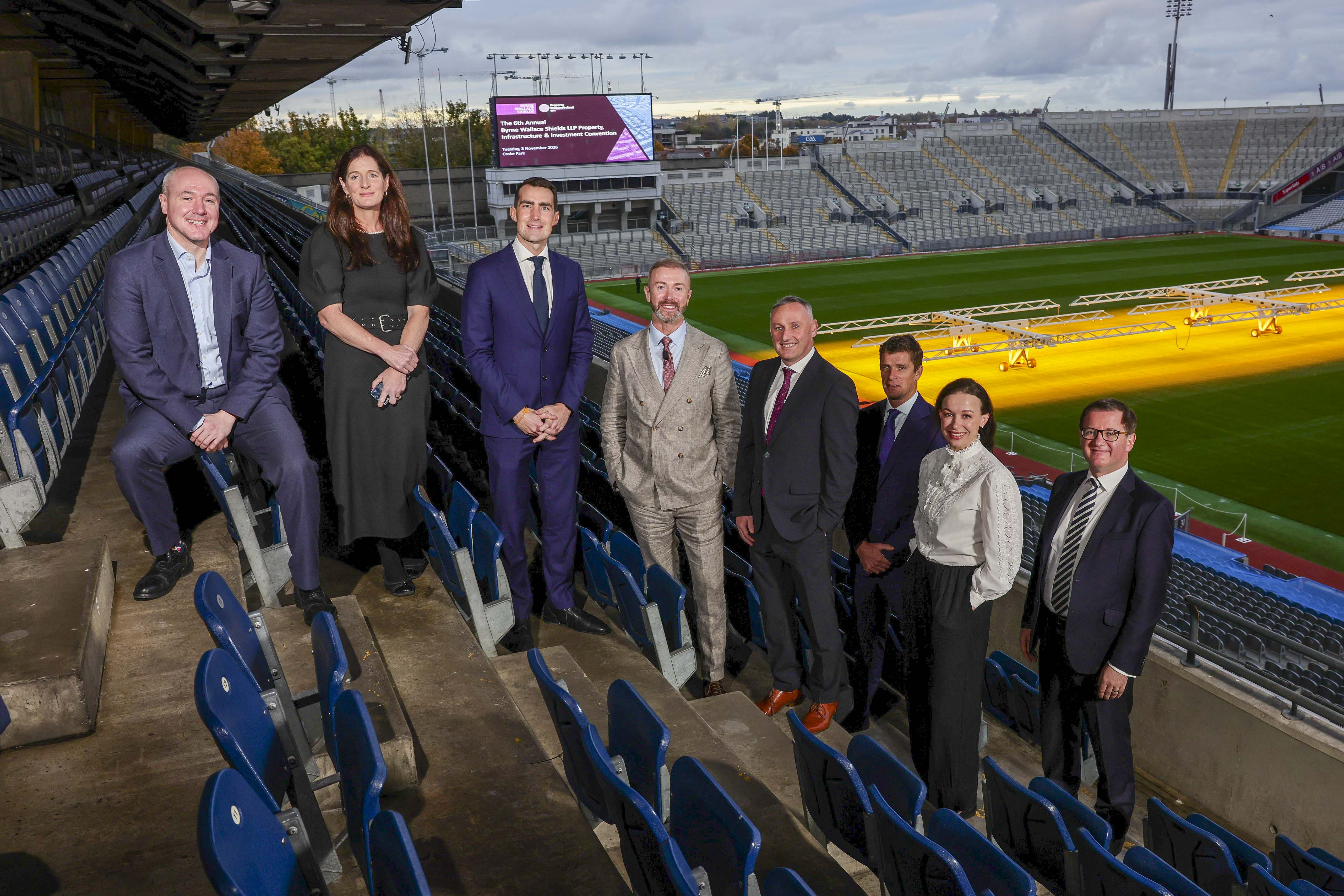
On Tuesday 3 November, leaders from the property, infrastructure and investment sectors gathered at Croke Park for the 6th Annual Byrne Wallace Shields LLP Property, Infrastructure & Investment Convention, presented in association with Property Industry Ireland. The Convention opened with a keynote address from Minister for Public Expenditure, Infrastructure, Public Service Reform and Digitalisation, Jack Chambers, TD. The morning delivered perspectives from Goodbody, Dublin City Council, IDA Ireland and Invesco Real Estate. Panels on Property, Infrastructure and Capital were moderated by Byrne Wallace Shields LLP partners Neil Dunne, Fergal Ruane and David Naughton and the Convention was chaired by Michael Walsh, Partner and Chair of Property.
Exploring the proposition "Capital, Confidence and Delivery: Ireland's Built Environment at an Inflection Point", three themes came through clearly across the morning: delivery, stability and confidence.
Delivery
Over the last year, the centre of conversation has moved considerably from bottleneck, reform and aspiration towards actual delivery of our built environment. The National Development Plan represents the largest ever long-term investment in housing and infrastructure in the history of our state. The reforms of recent years were described as transformative and the work of the Accelerating Infrastructure Taskforce, summarised as "Simplify, Streamline, Derogate, Deregulate", was repeatedly commended, with delegates being called on to become champions for delivery.
The turning point was the realisation by both Government and the public that housing cannot be delivered without better infrastructure, and Ireland has reached a point where it cannot continue with “business as usual”. The room echoed the National Development Plan’s ambitious outlook, with Dublin committed to plans for generational investment, including the Dublin Drainage Scheme, MetroLink, DART+, BusConnects and Powering Up Dublin. The importance of ensuring water, energy and digital infrastructure keep pace with those projects is essential, with grid capacity and distribution a recurring point of deliberation throughout the discussions. Supply chains, workforce and approvals remain challenges to delivering multiple projects at once and emerged as areas where further reform will be required.
Stability
The sense from industry leaders is that Ireland's political and economic stability is playing in its favour. Ireland is not in a building recession, unlike many of its EU neighbours, and Government funding schemes were credited for this. The challenge will lie in sustaining that stability in the run-up to some of the most significant infrastructure projects in the State’s history.
The balance between viability and stability became clear during discussions around the challenges that remain for large apartment schemes, which require ongoing Government support such as Croí Conaithe. The convention heard that an apartment in Dublin currently costs between €500,000 and €600,000 to build, some €100,000 or more ahead of what the individual unit purchasers can realistically afford and fund. The gap was described as structural: returns are tight for investors and developers, and higher interest rates are a threat to private housing output on the developer’s side as well as to buyer affordability. Social and affordable delivery is valuable, but should not become the only exit for apartment schemes. Further interventions were suggested to improve apartment viability and as regards affordability for workers currently priced out of home ownership. While the recent temporary reduction of VAT from 13.5% to 9% for qualifying new apartments was welcomed, it was suggested that there was more to be done in this field to bridge the affordability gap.
Private investment is cautiously returning to the PRS sector but so far evidence of this has been seen in a relatively small number of large value transactions of existing apartment stock. The convention heard that these green shoots do not signal this is the time for Government to step away. Private capital has yet to return at scale to forward fund residential projects, barely seen in approximately four years. Multi-year planning and funding would help, and the challenge now is to sustain momentum with funding and further reform. Energy security is part of the same picture: with 80% of Ireland's energy imported, an improved long-term strategy is needed.
Confidence
Increased financial volatility has created more challenges. Capital is returning, but conviction is concentrated, with structural demand directing activity towards selected living, logistics and data-led sectors. Investors are following three principles for the next real estate cycle: diversify globally, prioritise resilient income, and follow structural change.
The convention was marked by encouraging signs for Ireland. The return of sovereign wealth funds into the Irish market was welcomed as a positive sign that will help attract further international institutional capital. Confidence also had to be rebuilt to bring more major contractors into Ireland, and a visible pipeline of large-scale projects is essential to keep them. A very small proportion of Irish pension assets is currently invested in housing and infrastructure in Ireland. Pension auto-enrolment, master trusts and the new personal investment accounts create opportunities for change. The convention heard of a growing case for more private capital allocations to the domestic market.
A core message, underpinning the other themes, was the need for confident championing – across political, business and civic leadership and in the various branches and authorities in the State. There is a need to effectively communicate the benefits of critical infrastructure to win hearts and minds.
Looking ahead
The tone of the Convention was optimistic and the clear consensus was that property, infrastructure and capital can no longer be treated as separate conversations. Ireland needs a vibrant housing and infrastructure sector for capital to invest in, the stability to sustain it, and the confidence to deliver it at scale. Success can bring complacency, and Ireland should stay hungry to get things done. With a sense that the State is taking less of a “no-risk” and more “can do!” approach, and backing that with the multi-annual funding commitment through the Development Plan, watch this space.
To read more about the Convention, including video highlights from the day, see our press release, here.